What’s the best coffee you’ve ever had?

The student asking this question has been taking notes all morning. Highlighted. Color-coded. Tabs. She looks like someone who owns a Chemex and refers to it by name, like a pet.

bakery in paris Petrin

I could lie.

Tell her about a Gesha I cupped in Panama. Mention bergamot, stone fruit, complexity. Say something impressive and technically correct.

But I’ve been teaching long enough to know that the truth is more useful, especially when it makes me look ridiculous.

A paper cup from a bakery in Paris,” I say.
Over-extracted espresso. Milk steamed to approximately the temperature of the sun.

She blinks. The way people blink when you tell them you prefer Olive Garden to actual Italian food.

Here’s what happened.

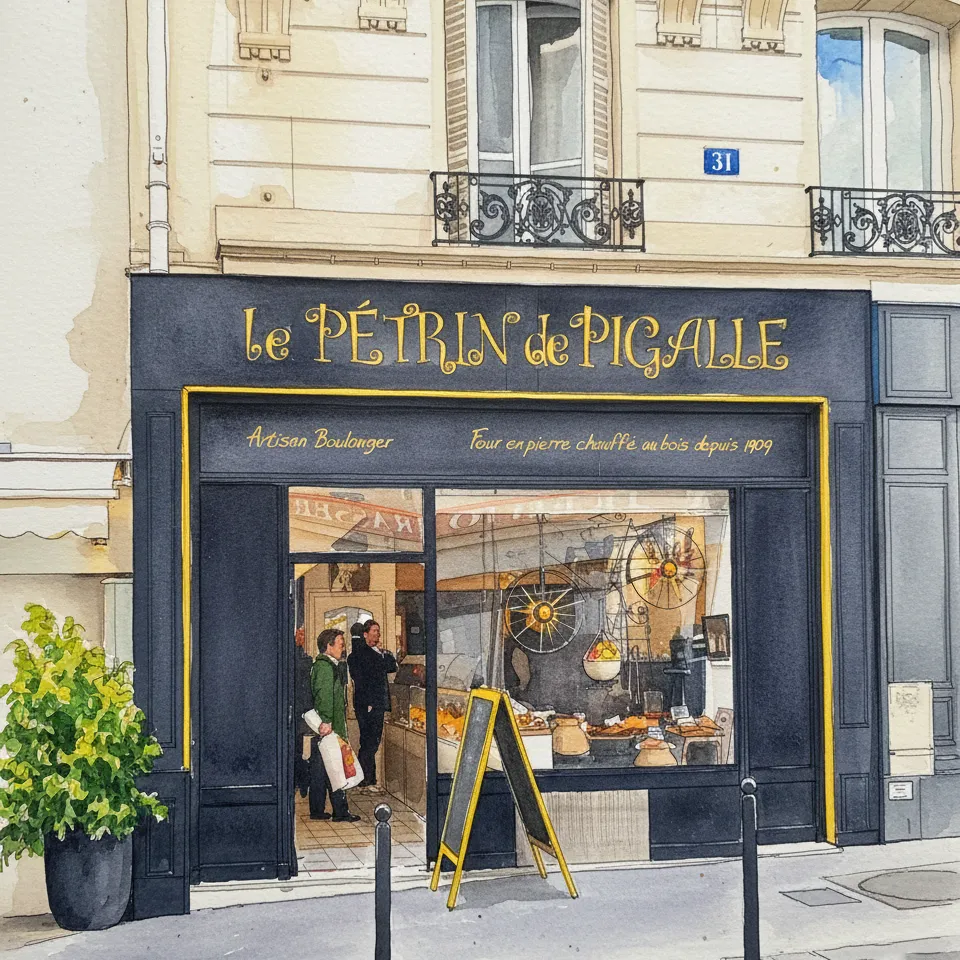
boulangerie in paris Le Pétrin de Pigalle

In 2021, my son and I flew to Paris. Which sounds glamorous until you factor in ten hours on a plane and waking up at an hour that feels illegal. Still on California time, we went looking for breakfast.

I’d been studying French on Duolingo. Five months.
I was ready.

Je voudrais un pain au chocolat, un pain au raisin, et deux cafés au lait,” I announced at Le Pétrin de Pigalle.

The woman behind the counter looked at me.
Et?

And what?
What did I miss?

I tried again, adding hand gestures.
C’est tout.

Et?

Maybe French wasn’t working. Let’s try Italian.
Basta.

Wrong country.

Et?

At this point I briefly considered asking Duolingo for a refund. Then I remembered I was on the free plan, which meant I had exactly zero leverage.

She leaned forward and said, slowly and carefully, the way you might speak to a dog you are trying to train:

S’il. Vous. Plaît.

Oh.
Oh no.
I forgot to say “please“.

You can respond to this moment in two ways. You can get offended and leave. Or you can repeat after her like a well-trained parrot.

S’il vous plaît,” I said, matching her tone exactly.

BRAVO!

I felt the same pride I’d felt when my first ever coffee customer said “this coffee is drinkable“.

My sixteen-year-old son watched this entire interaction without flinching. I think we were both equally invested in getting that pain au chocolat.

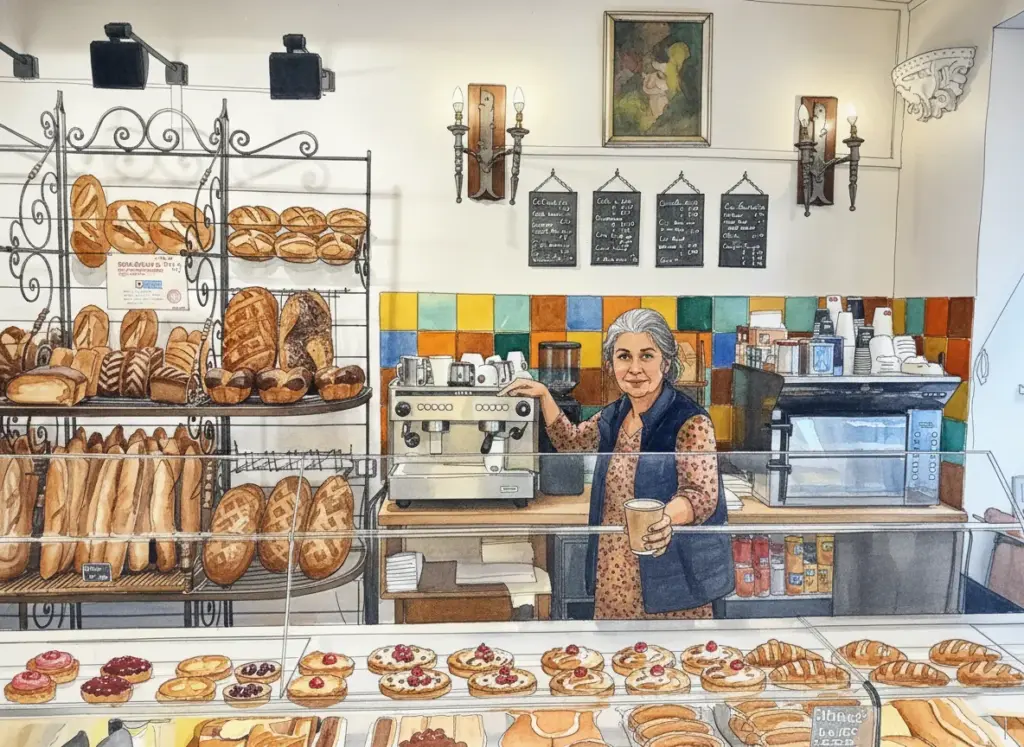
The other woman made our coffee. She ground the beans, loaded the portafilter, and started pulling a shot on what appeared to be the same machine they’d used to make coffee for the Resistance. The espresso ran for what felt like a full minute. The crema started out promising, then faded, then disappeared entirely. By the end it was just hot water with a vague memory of coffee.

Then came the milk. Steamed to a temperature that could strip paint. Frothed into something that looked like it belonged in a bathtub. She snapped a plastic lid on top and handed it over.

We paid, said “merci” (I remembered this time), and escaped into the morning.
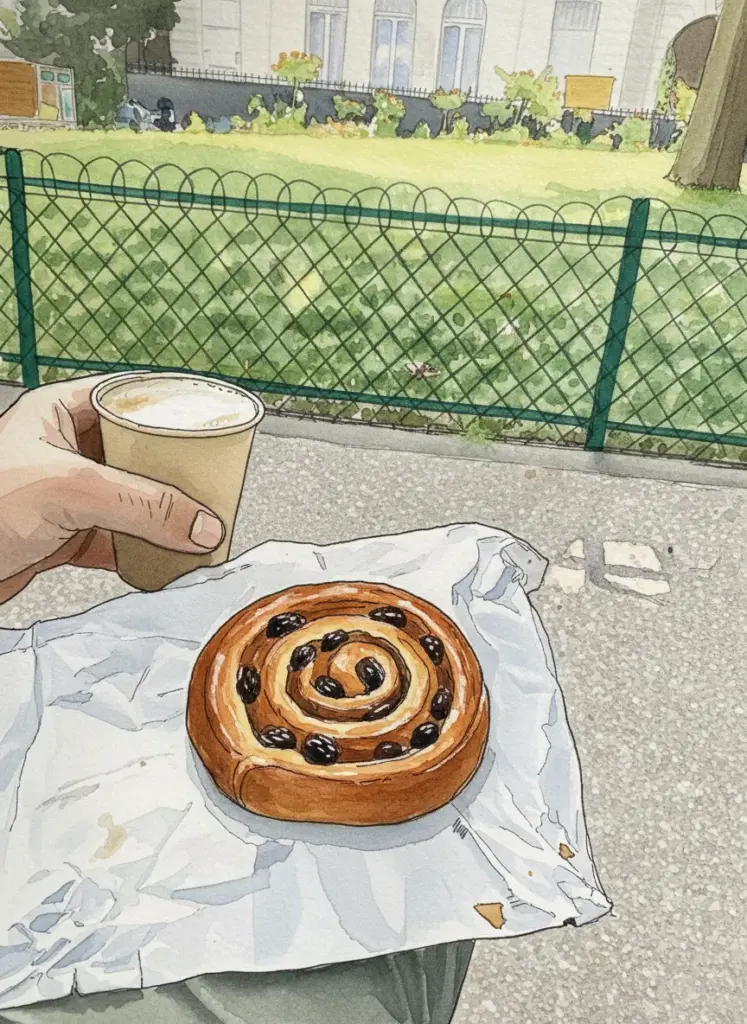
pain au resin

Paris at 7 a.m. is beautiful, but not especially helpful to jet-lagged tourists clutching paper cups of liquid magma. Every bench was wet from cleaning. People walked past us looking purposeful and French while we stood there looking lost and American.

I saw families going through a gate and followed them, either resourceful or creepy, depending on perspective. Luckily, it was a park.

We found a bench under a tree. The sun was coming up. I bit into the pain au raisin and took a sip of the coffee.

And it was perfect.

That café au lait was the best coffee I’ve ever had.

Not because of the coffee itself. By any professional standard, it was a mess.
But coffee never exists in isolation. It shows up inside moments, not spreadsheets.

It was the sunrise in Paris.
It was the jet lag finally loosening its grip.
It was the relief of sitting down after wandering the one of the most magnificent cities on the planet  half-awake.
It was a warm cup in cold hands.
It was the quiet luxury of having nowhere to be.

It was also the person I was sharing it with. Somewhere between the pastry and the second sip, I realized I was not just sitting with my son. I was sitting with a smart, thoughtful human being. I did not stop to analyze it. I just noticed it. The way you notice things when coffee gives you permission to slow down.

That is the part people miss when they talk about coffee only in terms of brew ratios and extraction curves. Coffee is culture. It is stories. It is meetings and dates. It is family time and campfires. It is early mornings alone and long conversations that go nowhere. The best human moments tend to arrive with a cup in your hand.

That morning in Paris changed how I think about coffee. It made me a better trainer. Not because I lowered my standards, but because I raised my understanding of what coffee is actually for.

I tell this story to my students and watch their faces change. Some get it immediately. Others look concerned, like they’ve just realized their instructor might be unreliable.

Eventually, most of them understand.

And if they don’t, they risk spending their lives making technically flawless coffee that nobody remembers.

Author :

>