What Three Ikawa Roast Profiles Taught Me About My Own Assumptions

Last year I was hired to source coffee for Q Specialty, a coffee shop in San Francisco. I spent weeks cupping through lots, selecting what I was confident were exceptional coffees. Then I went to see how they performed in the coffee shop. They were not what I remembered.

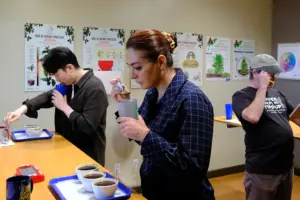
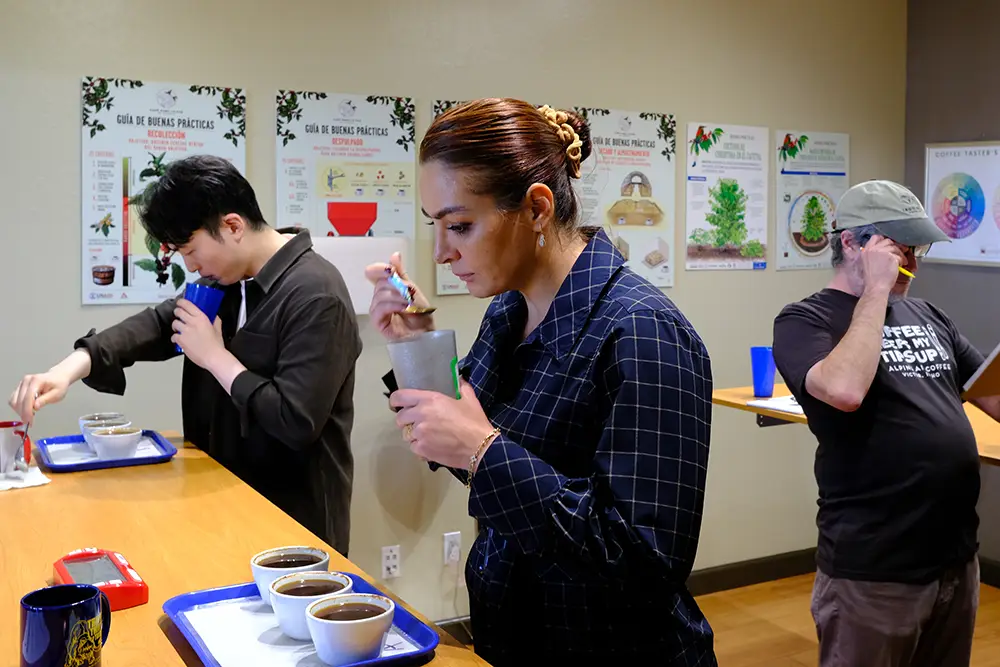
Students tasting coffee via cupping

They were somehow muted compared to what I had tasted during selection. The brightness, the complexity I had bought those coffees for, was somewhere underneath the surface.

My first instinct was that I had made a mistake. That the coffees I selected were not as good as I thought. So I re-roasted them on my Ikawa sample roaster and cupped them again. They were fine. More than fine. The quality was there.

The problem was not the coffee. It was the profile.

The Bellwether roaster Q Specialty uses runs a complete roast in nine to ten minutes. I teach that fluid bed roasters, which use hot convection air as the primary heat source, perform best with faster profiles.

The Bellwether is a fluid bed machine. Its default profile was doing something to those coffees that my Ikawa cupping profile was not.

I could not run a controlled experiment on the Bellwether. But I could run one on the Ikawa.

Testing Fast, Medium, and Slow Roast Profiles on the Ikawa Pro 100x

I designed three profiles on the Ikawa Pro 100x, all targeting the same roast color: Agtron ~60-64 (coffee dependent) on bean, plus or minus two points. The 100x automatically detects first crack based on moisture release, which removes one variable from the comparison. That said on the Kona coffee it detected the FC incorrectly as you can see from the charts. I have a full article for you about the Ikawa 100x first crack detection reliability. Same coffee for all three. Same green weight. The only variable was time.

Fast: 4 minutes 27 seconds. First crack at 3:36.
Classic: 6 minutes 30 seconds. This was my standard cupping profile, the one I had been using for years. First crack at 5:48.
Slow: 9 minutes 29 seconds. First crack at 8:46.

In some cases I had to adjust the end temperature to get better color match. 

Ethiopia Chelchelle Natural

A

Ikawa 982 slow

Long profile 

B

2e9

Our traditional cupping profile

C

ikawa 586

Superfast – Go Crazy profile

The coffee was Ethiopia Chelchelle, a natural process from our friends at Genuin Origin. A Yirgacheffe-region coffee with enough fruit and floral character to show clearly what a profile was doing to it.

Before I brought this to anyone else, I ran the test myself. Blind.

The Fast profile scored highest. The Classic finished last. My notes on the Classic: muddy, mustard. On the Fast: most fruity, clean, lively. On the Slow: chocolate, fruit, floral, with a bitter aftertaste.

The profile I had been using as my standard evaluation roast for years came last on my own palate.

I decided I needed more tasters. And I happened to have fifteen of them arriving the next morning.

What 15 Tasters Found in a Blind Taste Test

In April 2026, I was wrapping up an SCA Sensory Skills course at Boot Coffee Campus in San Rafael. By the final day, the students had spent the week calibrating their palates, working through the SCA methodology, learning to evaluate coffee systematically. They were as prepared as a group of fifteen people can be.

I set up the three cups blind, labeled A, B, and C. I asked everyone to evaluate using the SCA Affective form and score overall impression on a scale of one to nine. I did not tell them what they were tasting or why.

Willem Boot, one of the most respected figures in specialty coffee and the founder of Boot Coffee Campus, was also in the room. He joined the evaluation.

The scores came in.
Totals across all tasters:
Fast (C): 121 points
Slow (A): 115 points
Classic (B): 102 points
The Classic lost. Again.

Among the thirteen students, not one person chose the Classic as their preferred cup. Zero out of thirteen. Seven preferred Fast. Four preferred Slow. Two could not separate Fast and Slow and scored them equally.

Keep in mind what the Classic is. It is not some arbitrary middle profile. It is the profile I use to evaluate green coffee. The profile that informed the sourcing decision at Q Specialty. The profile I have trusted for years as a neutral, reliable reference point. I designed the Fast and Slow as deliberate extremes, expecting them to be instructive edge cases. I did not expect them to win.

The average spread between a taster’s highest and lowest score was 2 points on a 9-point scale. These were not dramatic differences. Thatcher (@limacoffeeroasters) gave the Slow an 8 and described it as “clearly the sweetest and brightest of the three.” Michelle gave the Fast a 9, noting it was the sweetest with the most flavor. Azar gave the Slow a 9, the highest individual score in the room. Eric described the Fast as having “the best balance, best aftertaste.” Shaina (@shaishai3000) preferred the Slow, noting “most fruit, mandarin, brown sugar.” Lixon (@bouquetandberry) chose Fast as first place, writing that it had “more delicate nuances that maintain their pleasantness as it cools.”

Willem Boot scored the Classic an 8. His top score. He gave the Fast a 5.

His notes on the Classic: sweet balance, smooth. On the Fast: astringent, drying. On the Slow: lime, green mango, mildly astringent, lacking balance.

The most experienced palate in the room reached the opposite conclusion from the group. He was not wrong. The Classic gave him sweetness and balance. The Fast gave him astringency. Different palates, different histories, different results.

This is not a contradiction. It is the point.

Ikawa Roast Profile Experiment — Ethiopia Chelchelle Natural

Overall impression scores · SCA Affective Form · Boot Coffee Campus · April 3, 2026 · n=15

Slow (A) · 9:29 min
115
avg 7.2 · 4 preferred
Classic (B) · 6:30 min
102
avg 6.4 · 0 preferred
Fast (C) · 4:27 min
121
avg 7.6 · 7 preferred
Slow (A) Classic (B) Fast (C)

Agtron 64 on bean · Ikawa Pro 100x · Coffee: Ethiopia Chelchelle Natural, Genuin Origin

Our traditional cupping profile

Gesha and Kona: Does a Slow Roast Profile Hold Up on Delicate Coffees?

A few weeks later I repeated the test with two different coffees, this time tasting with Willem Boot.

First, Gesha Village Estate OMA Natural, one of the most complex and delicate coffees produced anywhere. Then Hawaii Kona Hulalai Estate Washed, a coffee where subtlety is the whole game.

On both coffees, the Slow profile won. On the Kona, my notes read: chocolate, pepper, spice, caramel, very expressive. The aroma stayed expressive as it cooled. Willem agreed. He favored Slow on both.

The Fast profile, which the student group had preferred on the Chelchelle natural, stepped back on these coffees. The Slow had room to work.

Gesha Village Estate Oma Gesha 1931 Natural

ikawa roast profile

Color: Agtron 58

ikawa 8f6

Color: Agtron 59.2

ikawa c19

Color: Agtron 60.2

Hawaii Kona Hulalai Estate

ikawa coffee roast profile

Color: Agtron 65.2

ikawa roast profile

Color: Agtron 64.9

ikawa 8b8

Color: Agtron 64.3

Across three coffees and three separate tastings, the Classic finished last every time. The extremes we built as edge cases turned out to be the better roasts.

Why Your Roast Profile Log Does Not Tell You If the Coffee Tastes Good

All three profiles returned similar colors per coffee. This is crucial when it comes to customers’ perception of the coffee, but they did taste different. We knew they would, but our past theories and knowledge told us something else.

The truth is that a profile log does not tell you whether the coffee tastes good. It tells you what you did. Whether what you did was right for that particular coffee on that particular day is a question only the cup can answer.

I had been using the Classic profile long enough that I stopped asking the question. It was the reference. The baseline. And as it turned out, a mistake not to question it. The thing I measured other roasts against. Running it against two deliberate extremes, on a coffee I knew well, in front of people with no reason to be polite about it, was the only way to find out whether my baseline was actually serving the coffee. It was not.

The conventional teaching about fluid bed roasters and fast profiles probably holds in many situations. The physics behind it are real. But physics describes what is possible, not what is optimal for a specific coffee. The Chelchelle, the Gesha, and the Kona each had their own answer. The only way to find it was to taste.

What This Experiment Does and Does Not Prove

This experiment does not prove that the Bellwether slow roast profile is good or bad, and it does not mean you cannot get great coffee from that machine. I do not have a Bellwether in my lab, so my honest answer is I DON’T KNOW. But I am curious.

A few things this experiment is not:

  • It is not a case for using a long profile on the Ikawa from now on. Determining which profile is best would require more experiments, and the answer is coffee-dependent anyway.
  • It will not change how I approach sample roasting. Sample roasting is about determining the POTENTIAL OF THE COFFEE, not finding the “best profile.” And in most scenarios, the differences between these three cups were minor.

A few things this experiment is:

  • It will force me, and I hope you too, to question everything a little more deliberately.
  • It will make me taste coffee more and look at charts a little less. Which, honestly, I was already doing. 😎
  • And it will hopefully provoke you to step outside your comfort zone, run some experiments of your own, and share them with me. 🤟

Run the Experiment: Get the Ikawa Profiles Sent to Your Inbox

Ikawa Subscription Form

You need three batches of the same coffee, a color meter, and brave people willing to taste without knowing what they are drinking.

Match your color target across all three batches. Keep everything else the same. Then taste blind.

The three profiles from this experiment were developed on the Ikawa Pro 100x. If you have an Ikawa, leave your email below and I will send them to you directly. Load them, if possible make sure all return the same color on bean, and run the test on whatever coffee you have in front of you.

If you are on a different machine, use the time and temperature parameters as a reference and adapt to your equipment. The principle of testing 3 very different profiles is the same.

Big thanks to my incredible students who participated in this experiment. They had not been taught what a slow profile should taste like. They just blindly tasted, scored, and wrote what they found. Eshan (@edayal2), Yoko (@casadecafe_jp), Daniel (@my.string), Tzeyun, Drew, Zhuojin (@ericzh001), Georgie, Azar (@azita.1981), Michelle, Eric, Lixon (@bouquetandberry), Shaina (@shaishai3000), Thatcher (@limacoffeeroasters).

Leave your email below. The profiles will land in your inbox.

One thing I can tell you with confidence after running this experiment: the coffee that surprised you is the one worth understanding.

Author :

>